Project scope
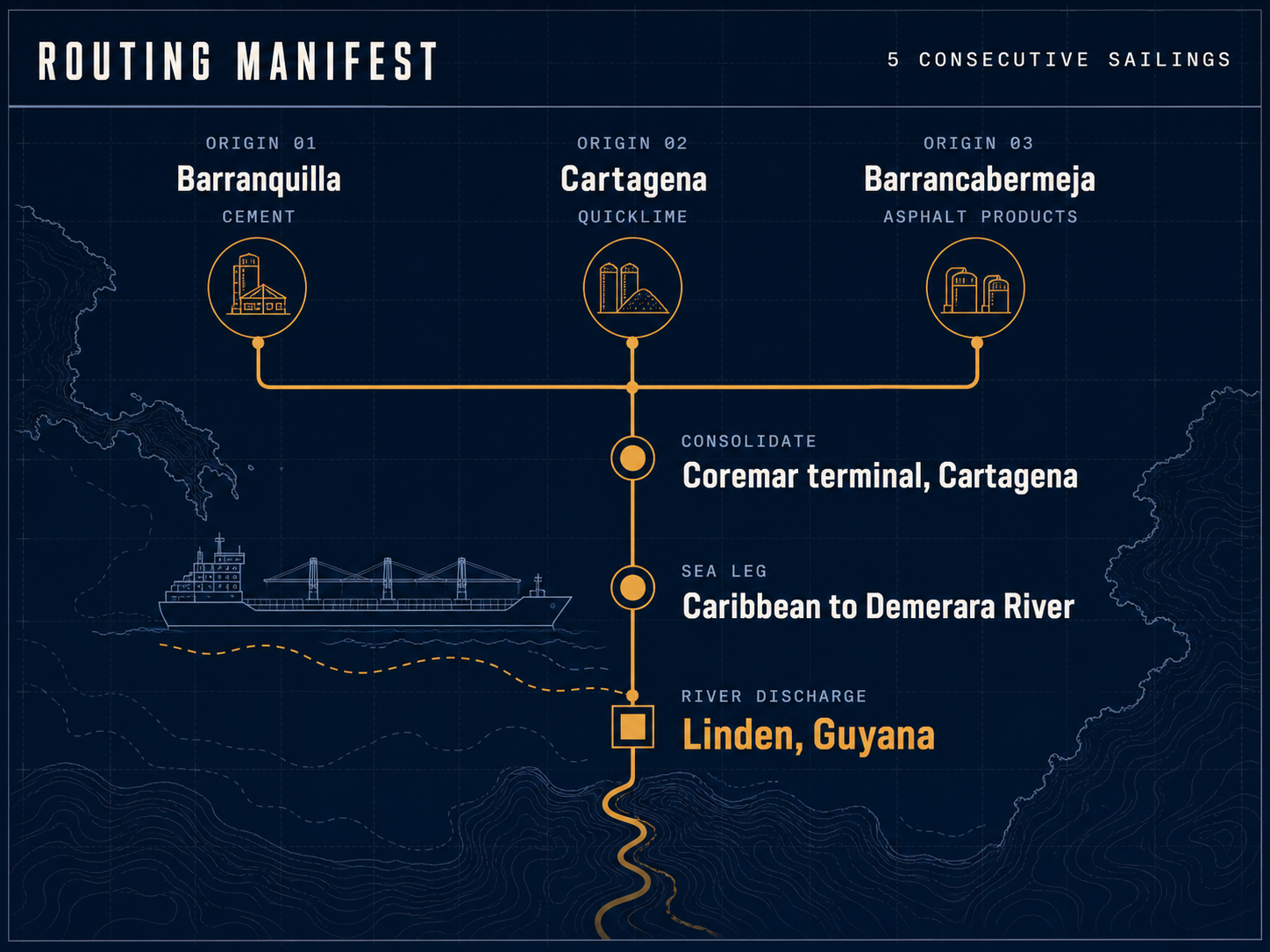
Five sailings supplied materials for the 121-kilometre road project
The Linden-Mabura Hill road is a US$190 million project supported by the Caribbean Development Bank, the United Kingdom and the Government of Guyana. Pro Road could source the cement, lime and asphalt products in Colombia. The operation required a route that delivered one consolidated parcel close to Álya Construtora's works base and avoided long-haul trucking from Georgetown.
Bulkargo's scope covered vessel search and chartering, lifting-gear engineering, inland consolidation and port operations, customs and export clearance, stowage and cargo care, destination landing and pilotage advice, agency at both ends, and commercial exception settlement.
- End client
- Álya Construtora, Linden-Mabura Hill road contractor
- Shipper
- Pro Road group of companies
- Cargo
- Portland cement, quicklime and asphalt cement in big bags; asphalt emulsions and cutbacks in steel drums
- Programme
- Five sailings from October 2023 through 2024
- Parcel size
- 3,200 to 3,500 tonnes of mixed break-bulk per sailing
- Vessel
- MV Pera, geared general-cargo vessel, 3,500 DWT
Operating constraints
Bridge clearance, river draft, landing condition and cargo units constrained the fixture
The operation did not fit a standard liner booking. Bulkargo assessed the destination constraints before evaluating vessel and origin requirements.
No scheduled service covered the route
No liner service could collect the mixed parcel from three Colombian origins and deliver it to the river landing near the works. The programme needed a dedicated charter and one consolidation point.
The route limited the vessel dimensions
The ship had to clear the old bridge opening, work a tidal river draft, carry close to 3,500 tonnes and provide suitable onboard gear. Cargo capacity alone did not produce a viable shortlist.
The receiving point had no working berth
The receiving point began as an unserviceable three-pile landing. It could not safely accept a loaded vessel alongside and had no shore gear for discharge.
The cargo units required separate handling controls
Quicklime had to remain dry, bagged asphalt could deform under heat and load, and steel drums could not carry bag tiers. An unsuitable stowage plan could damage several cargo grades at once.
Governing constraint
The vessel needed the beam and air draft for a once-daily bridge opening, the loaded draft for a tidal river, enough deadweight for the parcel, and onboard gear capable of working a landing with no shore cranes.
Bulkargo coordinated seven operational workstreams
Vessel selection, cargo readiness, handling design and river planning proceeded concurrently. A delay in any activity could have delayed the sailing.
- 01
Vessel selection began with the destination limits
Candidates were screened against the bridge beam and air-draft limits, then against the tidal river's loaded-draft limit. Deadweight, hold volume and crane capacity were assessed after confirming that a vessel could reach Linden.
- 02
Bulkargo commissioned purpose-built lifting gear
Bulkargo arranged the design and manufacture of spreaders and lifting accessories in Colombia. The system lifted twelve 1.5-tonne big bags in one cycle, up to 18 tonnes per lift, reducing roughly 2,000 individual bag lifts to about 170 cycles per sailing.
- 03
Bulkargo consolidated cargo from three origins
Cement moved from Barranquilla, quicklime from Cartagena, and asphalt products from Barrancabermeja. Bulkargo selected Coremar in Cartagena for staged receipt, storage and segregation before the vessel arrived.
- 04
Bulkargo coordinated export clearance
Customs agency work and the Colombian antinarcotics inspection were coordinated alongside cargo accumulation, keeping the vessel out of a documentary hold once the parcel was complete.
- 05
The stowage plan separated incompatible cargo
The plan isolated quicklime from moisture, protected bagged asphalt from heat and compression, and kept bag tiers off the drums. It also set the discharge order before loading began.
- 06
Bulkargo managed commercial coordination
Bulkargo negotiated with the owner, appointed agents in Colombia and Guyana, and coordinated third-party payments. Bulkargo was the sole commercial contact for the shipper and receiver throughout the operation.
- 07
Bulkargo planned the landing and tidal window
The team advised on improvements to the receiving landing and planned draft alongside, under-keel clearance, pilotage, distance and timing. Discharge then followed the Demerara tidal cycle.
Outcome
The same vessel completed five consecutive sailings
| Dimension | Result |
|---|---|
| Delivery | Five sailings and approximately 17,000 tonnes fully discharged at Linden within the available tidal windows. |
| Repeatability | The same vessel completed the following four voyages, which established a repeat operation. |
| Commercial close-out | Delays were settled by agreement between the parties, without dispute or arbitration. |
Discharge at Linden avoided Georgetown road haulage
The alternative was discharge at Georgetown followed by road transport to Linden. The client's operating figures put a truck payload at 30 to 35 tonnes and a trip at US$2,000 to US$2,500. Sailing to Linden added about one day of steaming and removed the long-haul Georgetown-Linden leg from the programme.
Long-haul trips avoided
Approx. 485-570
17,000 tonnes divided by 35 to 30 tonnes per truck
Gross trucking cost avoided
US$0.97M-1.42M
Avoided trips multiplied by US$2,000 to US$2,500
Equivalent per tonne
US$57-83
Gross avoided road-haulage cost per delivered tonne
Route update
The new Demerara River bridge removed the former opening restriction
Guyana opened the 2,798-metre Bharrat Jagdeo Demerara River Bridge on 5 October 2025. Its approximately 50-metre clearance allows Handymax vessels to pass without a retractable opening. River draft, tide and the upper-river landing still govern access to Linden, but the old once-daily bridge window and beam restriction no longer limit vessel selection to the same degree.
Current access constraints
- River draft and tidal range
- Landing depth and under-keel clearance
- Pilotage and upper-river transit planning
Sources and scope
Sources and calculation basis
Operational record
Tonnages, sailing count, vessel particulars, handling configuration, cargo-condition outcomes and the road-haulage comparison come from Bulkargo and client operating records for the five voyages.