What is steel as a sea-borne cargo?
Finished steel products (coils, plates, billets, rebar and structural beams) ship as semi-bulk and break-bulk cargo. They fall under the IMO Cargo Stowage and Securing Code, and no single IMSBC schedule covers them. The main risks on a steel fixture are lashing failure in heavy weather and rust claims at delivery.
“Steel shipping” covers a family of cargoes. They come from the same place (the steel mill) and fall under the same rules (the IMO CSS Code). In the hold, they look very different. Hot-rolled and cold-rolled coils, plates, slabs, billets, rebar bundles, structural beams and wire rod each stow in their own way. Most ship as break-bulk (separate pieces) or semi-bulk on standard bulk carriers and tween-deckers. They seldom ship as uniform loose bulk. The main rulebook is the IMO Code of Safe Practice for Cargo Stowage and Securing (the CSS Code). It sets the lashing, dunnage and securing rules for steel shipped in units. The IMSBC Code 2024 covers steel only in bulk form. That mainly means steel swarf and turnings, under the schedule FERROUS METAL BORINGS, SHAVINGS, TURNINGS or CUTTINGS (UN 2793). That schedule is Class 4.2, Group B, because the material can heat itself and can catch fire on contact with air.
Steel also trades differently from bulk commodities. A steel parcel is usually a mix of grades and sizes for one end buyer. Each parcel and each coil has a mill certificate, and the receiver inspects every unit at discharge. That pushes steel toward Handysize and Supramax ships whose crews know lashing well. It also favours owners whose P and I cover is set up for steel rust claims. The largest steel parcels (50,000 tonnes plus on one bill of lading) come close to project cargo. They are often a more natural fit as project cargo with a tween-decker or heavy-lift partner than as a standard bulk fixture.
Steel cargo properties
| Property | Value | Unit / Reference |
|---|---|---|
| Material density | 7.85 | t/m3 (the steel itself; the loaded stowage factor depends on packing) |
| Coil outer diameter | 1.0 to 2.0 | m (typical hot-rolled coil) |
| Coil unit weight | 5 to 30 | t per coil (mill specification) |
| Plate thickness range | 3 to 100 mm; weight per sheet varies widely | Mill certificate per parcel |
| Billet length and weight | 6 to 12 m; 1 to 3 t per billet | Mill certificate per parcel |
| Rebar bundle weight | 1 to 5 t per bundle | Mill certificate per parcel |
| Stowage factor (coils) | 0.5 to 0.9 | m3/t (depends on coil size and how the coils are stowed) |
| Stowage factor (billets and rebar) | 0.3 to 0.6 | m3/t |
| Stowage factor (ferrous turnings bulk) | 0.4 to 0.6 | m3/t (IMSBC Code 2024) |
| IMSBC schedule (where applicable) | FERROUS METAL BORINGS, SHAVINGS, TURNINGS or CUTTINGS, UN 2793 | Class 4.2, Group B, self-heating (IMSBC Code 2024) |
| Primary regulatory reference | IMO CSS Code (Code of Safe Practice for Cargo Stowage and Securing) | IMO Resolution A.714(17) and amendments |
| Securing requirements | Per CSS Code Annex 13; lashings sized to the forces from the ship's motion | Cargo Securing Manual for the vessel |
| Rust claim category | Atmospheric, sea water, sweat |
Vessel typing and parcel sizes
Steel moves on Handysize, Handymax and Supramax ships, and sometimes on Panamax. Tween-deckers and fitted geared bulk carriers suit coil and plate best. The lashing needs a deck or a flat tank top with enough rings or eye plates to lash to. Capesize ships do not carry steel. Above Panamax parcel sizes, heavy-lift and project cargo ships take over.
| Vessel class | Suitability | Typical parcel size | Notes |
|---|---|---|---|
| Capesize | Not used | Not standard for steel | Hold shape and lashing points are unsuitable; see Capesize |
| Panamax | Occasional | 30,000 to 60,000 mt | Used for long-haul billet and rebar when the parcel is big enough; see Panamax |
| Supramax | Workhorse | 25,000 to 50,000 mt | Geared 5x30 tonne ships handle coils with shore or ship cranes; see Supramax |
| Handymax | Used | 20,000 to 40,000 mt | Tween-deck versions preferred for mixed coil and plate parcels; see Handymax |
| Handysize | Strong | 10,000 to 30,000 mt | Geared and tween-deck ships; the main segment for steel break-bulk; see Handysize |
| General cargo / tween-decker | Specialist | 5,000 to 25,000 mt | Fitted holds and lashing eye plates suit steel well; see general cargo vessels |
Choosing a ship for steel comes down to three questions. First, does the ship carry a Cargo Securing Manual with drawings for stowing steel coils? Second, do the holds have eye plates or ring bolts strong enough for the lashing? Third, does the receiving port have shore cranes with coil spreaders, or must the ship discharge with its own gear and clamps? For most steel parcels, the best match is a geared Supramax with tween decks. A plain geared Supramax or Panamax is enough for a parcel of uniform billets or rebar. See vessel size comparison for dimensions, and voyage charter for how the make-up of the parcel feeds into freight.
How steel ships in practice
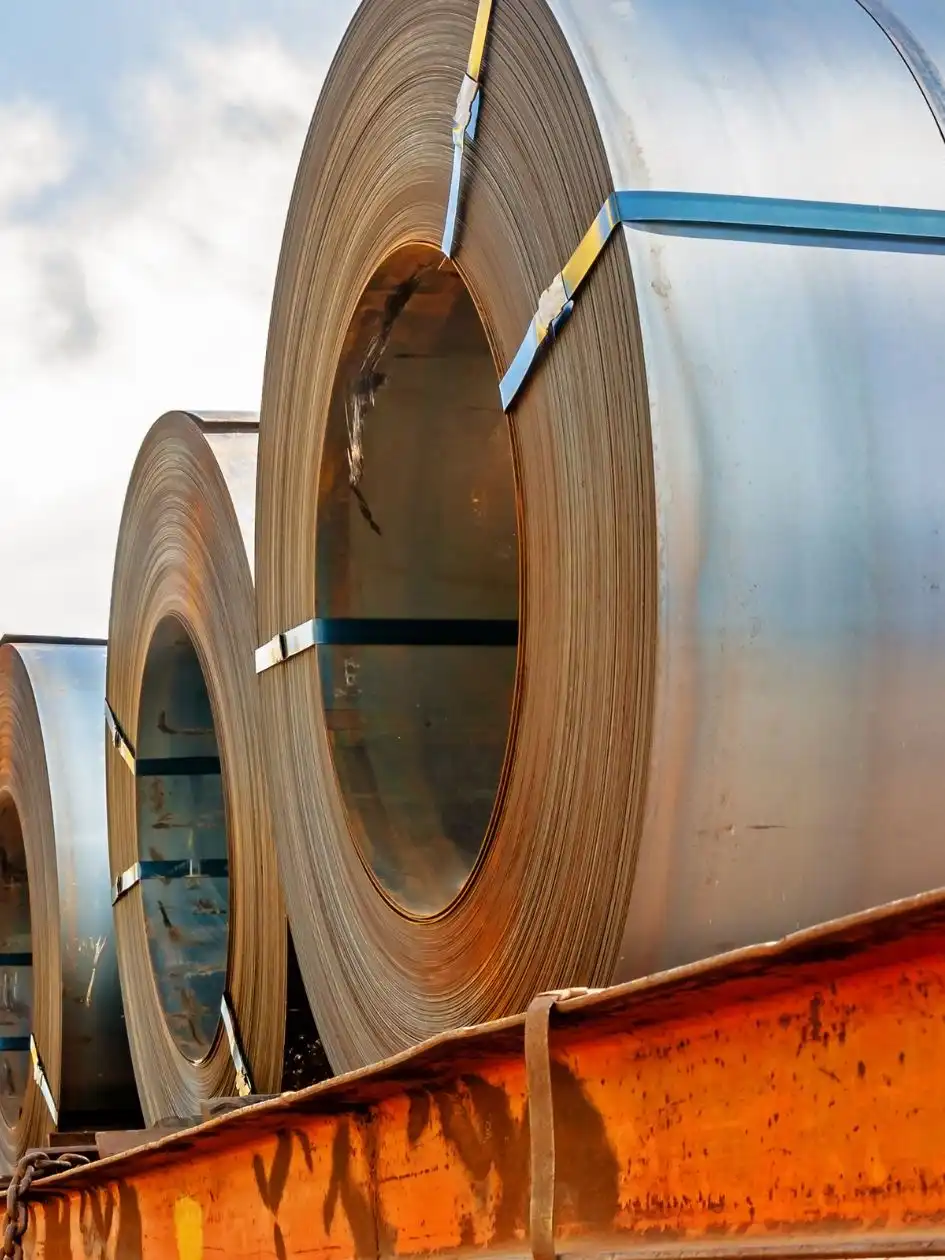
Steel loads by shore crane or ship’s crane with special gear. Coils go up on coil spreaders or C-hooks. Plates use plate clamps or spreader beams. Billets and rebar use chain slings or magnets. Hot-rolled coils usually stow with the eye facing the ship’s side, on hardwood dunnage (timber laid under the cargo). Timber wedges chock the bottom tier. A second tier sits in the hollows between the lower coils. The stow and the lashing plan must match the drawings in the ship’s Cargo Securing Manual. Any other layout needs the master’s approval against the CSS Code Annex 13 calculation method.
Lashing and securing matter more than any other step on a steel fixture. The CSS Code requires lashings to withstand the forces the ship’s motion creates in the worst sea state expected on the voyage. The whole securing system must stop single units and the stack from tipping or sliding. Poor lashing is the most common cause of steel damage at sea. It is a contract issue as well as a safety issue. UK P&I Club and Skuld guidance does not treat lashing failure alone as an automatic loss of cover. Their warning is about the bill of lading. You can put P and I cover at risk if you issue a clean bill of lading while you know the cargo is damaged or badly secured, because that misstates the cargo’s true condition. The clubs present proper lashing and pre-shipment surveys as loss prevention. They do not make them a strict condition of cover. Most steel fixtures require the loadmaster or an independent surveyor to sign off the lashing before notice of readiness is tendered at the load port.
Care during the voyage is about keeping moisture off the steel. Sweat is the main cause of rust claims at delivery. Sweat is condensation that forms under the hatch covers or on the hold sides when warm, humid air meets cold steel. The control is careful ventilation. The crew ventilates the holds when the dew point of the outside air is lower than the dew point of the air in the hold. They seal the holds when it is higher. Crews often get this timing wrong, and it drives many claims. At receiving ports, discharge by shore crane with a coil spreader runs at 2,500 to 5,000 tonnes per weather working day for coils. Billet and rebar go faster because they lift in larger units. See loading and discharge rate and demurrage for how these rates affect the economics of a fixture.
Major trade routes
Steel flows from the regions that make more than they use: China, Russia, Korea, Turkey and the EU. It goes to buyers in West Africa, Latin America, the Middle East and South-East Asia. The main routes for brokers are:
-
China to West Africa and the Middle East. China’s finished steel exports hit a record 119.02 million tonnes in 2025, per official customs (GACC) data. Southeast Asia and ASEAN remain the largest destination region by volume. West Africa and the Middle East are smaller secondary markets that are growing faster. Chinese mills export hot-rolled coil, rebar, billet and structural steel to construction and industry in West Africa (Lagos, Tema, Dakar) and the Middle East (Jebel Ali, Dammam, Sohar). Supramax and Handysize ships make round trips of twenty to thirty days.
-
China to Latin America. Coil and plate travel long-haul to industrial buyers in Brazil, Mexico and Chile. Panamax and Supramax ships take forty to fifty days one way.
-
Russia to Asia. Mills in the Russian Far East and on the Black Sea export billet, slab and rebar to Asia. The Black Sea route runs via Suez to South-East Asia. Volumes and routing have shifted a lot since 2022 because of sanctions. Check the current status of the route with the World Steel Association and the trade press before a fixture pitch.
-
Turkey to Mediterranean, Europe and the Middle East. Turkish electric-arc-furnace mills (Iskenderun, Aliaga, Karabuk and the Marmara cluster) export rebar, structural steel and coil to Mediterranean Europe, Egypt, the Levant and the Gulf. Most of it moves on Handysize and Supramax ships on short to medium voyages.
-
Korea to Asia and the Middle East. POSCO and Hyundai Steel ship high-grade hot-rolled and cold-rolled coil to industrial buyers in Asia and the Middle East, on Handysize and Supramax ships. Receivers demand high quality. Most of the risk on these fixtures depends on good lashing and careful sweat control.
For trade volumes, we use the World Steel Association annual statistical yearbook, export reports from the major mills, and the steel trade press. Check the current direction of each route against our routes and markets pages before you quote numbers in a pitch.
Steel and scrap metal: a cross-hub split
Finished steel and scrap metal are both metal, and they share some of the same shippers and buyers. Brokers sometimes need to tell them apart when an order comes in. They sit in different parts of this site on purpose. Finished steel ships in units as break-bulk under the CSS Code, so this page sits in the project cargo hub. Scrap metal is true loose dry bulk, poured or grabbed into the hold, so it has its own cargo page in the dry bulk hub. The fixtures work differently as a result.
| Finished steel products | Scrap-metal | |
|---|---|---|
| Form | Coils, plates, billets, rebar, beams (unitised) | Heavy melting scrap, shredded scrap, bundles (semi-bulk) |
| Regulatory home | IMO CSS Code (lashing and securing) | IMSBC Code (where in bulk); CSS Code where bundled |
| Stowage factor (m3/t) | 0.3 to 0.9 depending on form | 0.7 to 1.5 depending on density grade |
| Lashing requirement | Heavy and set for each unit (Cargo Securing Manual) | Lighter; mostly stays in place once trimmed |
| Discharge equipment | Coil spreader, clamp, sling for each unit | Grab, magnet, clamshell |
| Hold abrasion | Moderate (sharp edges on plate and rebar) | Severe (shredded scrap is the worst case) |
| Vessel preference | Geared Supramax, tween-decker, Handysize | Geared bulk carrier, often with reinforced tank tops |
| Claim risk profile | Rust, lashing failure, coil dent | Quantity dispute, contamination, tank-top damage |
The choice is simple. Mixed steel parcels with a mill certificate for each unit fix as steel cargo on tween-deck or fitted Supramax ships. Uniform scrap parcels at densities in the 0.7 to 1.5 m3/t band fix as bulk cargo on standard geared bulk carriers. Our scrap metal page explains how scrap fixtures work. Some parcels sit on the line, especially bundled rebar or wire-rod bales that look like break-bulk but ship like bulk. Check these unit by unit against the CSS Code Annex 13 calculation before the fixture is tendered.
Reference example
Supramax hot-rolled coils, China to West Africa
- Cargo
- 35,000 mt hot-rolled steel coils, mixed grades, mill-bundled
- Lane
- Tianjin or Lianyungang range to Lagos and Tema range
- Vessel
- Geared Supramax, fitted Cargo Securing Manual, 5x30 tonne cranes
- Coil size
- OD 1.5 to 1.8 m, unit weight 12 to 22 t
- Laycan
- 10 day window
- Loading rate
- 3,500 mt per weather working day SHEX
- Discharge rate
- 3,000 mt per weather working day SHEX
- Key clauses
- GENCON 2022 amended, lashing approved by independent surveyor at load, CSS Code Annex 13 calc on file, demurrage USD 16,000 per day pro rata, freight prepaid
The route is around 11,000 nautical miles via the Cape of Good Hope. Going via Suez saves around 2,500 miles when transit risk and canal costs allow it. Brokers should price both options against current Baltic Exchange tonnage signals and the receiver’s wishes on transit time.
The clause that requires lashing approval at load is the key step. The independent surveyor checks the coil stow against the ship’s Cargo Securing Manual and checks where the dunnage sits. The surveyor then signs the lashing plan against the CSS Code Annex 13 calculation. Any gap, especially in the chocking of the second tier of coils or in lashing pre-tension, will stop loading until it is fixed. That delay runs on the owner’s time.
Discharge in West Africa is slower than loading. The receiver’s coil spreader and the truck cycle limit how fast cargo comes off the ship. Freight is paid up front on this route because of counterparty risk. The bill of lading is worded to match, and the owner’s P and I club has approved the wording.
The fixture is anonymised. The figures show typical market terms for the route.
Common loading and discharge issues
- Lashing failure in heavy weather. This is the biggest source of claims on steel fixtures. Cargo that shifts because of poor lashing voids parts of the P and I cover and leaves the owner facing the cargo claim. The control is to follow the Cargo Securing Manual exactly. You should also require an independent surveyor to sign off the lashing plan before notice of readiness is tendered.
- Rust claim disputes (atmospheric, sea water, sweat). Receivers reject coils and plates that show surface rust at delivery. Investigators then trace the cause. Atmospheric rust is the producer’s risk, and sea water rust is the owner’s. Sweat rust is the owner’s risk if ventilation was wrong, and otherwise nobody’s. Mate’s receipts at load should record the surface condition honestly. That protects the owner’s defence at discharge.
- Coil tare weight disputes. Mill certificates show each coil’s weight, and the receiver weighs the coils again at discharge. Small differences, under one per cent, are routine. Larger ones trigger an investigation that can hold up discharge and put laytime at risk. The recap should state the agreed tolerance band.
- Dunnage and chocking failures during loading. Hardwood dunnage and timber wedges must be the right size and sit where the Cargo Securing Manual drawing shows. Cheap dunnage that splits under a coil’s weight weakens the whole lashing plan. The loadmaster’s sign-off on dunnage placement matters.
- Mixed-grade parcels with separation requirements. Coil parcels with several steel grades must be kept physically apart in the stow, so each coil still matches its mill certificate. Without that separation, the receiver can downgrade the whole parcel. The result is a dispute over the freight invoice.
- Sweat damage from ventilation error. The ventilation rule is to ventilate when the outside dew point is lower than the cargo dew point, and to seal when it is higher. It is one of the least intuitive controls in dry shipping. Crew mistakes here are the most common cause of marginal rust claims that technically fall on the owner under Hague-Visby.
Scope and what this page does not cover
This page covers bulk and break-bulk carriage of finished steel on dry bulk and tween-deck ships. It does not go deep into ferrous turnings, swarf or other Group B bulk steel by-products. It also leaves out steel in containers, heavy-lift project shipments above Panamax parcel sizes, and steel metallurgy. To plan a steel programme, work with our project cargo services desk. We work from current World Steel Association data and the ship’s Cargo Securing Manual. Check all CSS Code calculations against the current rules at the load port. To put a parcel to the market, send us the cargo and lane.